Every time when we met, during the last one and a half year, Simon Simonsen and me assured each other that we would use video conferencing as an innovative way to keep in contact. In the European project Vital Rural Area, Simon represents the Danish municipality of Vejen. About twice a year delegates of North East Friesland, Denmark and eleven other international North Sea partners congregate. Regularly, I'm attending, as advisor of the North East Frisian municpalities and of the Department of Economic Affairs of the Province of Fryslân.

F
rom left to right and form top to bottom: Sytze Nauta (Municipality of Achtkarspelen), Marc Crolla, Simon Simonosen (Municipality of Vejen), Gijs van Hesteren and Marcella Jansen (Municipality of Kollumerland). Picture: Kabel Noord.Meeting more often than twice a year would be preferable, but financial and practical considerations prohibit this. Nevertheless, these meetings are of utmost importance. The Interreg IV-B agency in Viborg demands 'transnationality and knowledge transfer'. Those two items are the most difficult aspects of any international project. Every participating region has its own - sometimes hidden - agenda and its own budget, and it's only human that they prefer to work on these aspects first.
On the other hand, if we want to learn form each other's best practices in Europe, we must try to share our secrets. Therefore, the Interreg Program pays a lot of attention to the international commmunication.
So, how did we solve this problem? The road to hell is paved with good intentions. Simon and me still had not gotten around to executing our promises. For a guy like Marc Crolla though, this was a piece of cake. He organised an international meeting about one of the Vital Rural Area projects, the Frisian
Klasseglas project.
Marc has specialised himself in ICT work processes, research and organisation, video communication and transitions in the Health & Education sector. He has a lot of experience in video conferencing. He developed hardware platforms and work protocols for educational institutions and e-Health pilots in Spain and the Netherlands. His proposal was to have an international meeting, using
Skype for an effective video conference.
Why skype? This platform is not yet compatible with video protocols like H323 and SIP, the generally accepted and age-old standards for video conferencing. That does not have to be problematic, though. Nowadays, tens of millions of users are connecting via Skype. For multi-point video conferencing, the big break has come with the latest bèta version of Skype 5. It's possible now, to make video connection for more than two users at the same time.
Of course, it's very probable, that the Estonian-Luxembourg company will develop compatibility with other internet protocols in the near future. A long time ago Skype enabled interconnection with mobile and fixed phone numbers, so why not with video protocols like H323? That aside, the platform is very cost effective. Installing Skype is free and if one eventually decides to uninstall it again, no money will have been wasted.
So, last week, we gathered around the virtual conference table. Beetsterzwaag, Dokkum, Surhuisterveen (NL) and Vejen (DK) spoke for about half an hour, with perfect sound and video and in real time. For two out of the five attendees, it was a totally new experience.
The first minutes, the participants needed to get used to the interface. Thanks to the protocol that Marc had developed, the chairman was able to lead the meeting effectively. For those who can read Dutch: read the weblog of Marc Crolla about this subject:
Denen helpen Friezen.
The next experiment will be to have meetings more frequently and with a larger number of participants.
Information about:
Vital Rural AreaKlasseglasNijFinsterKabel NoordBlog Marc CrollaDutch version of this blog
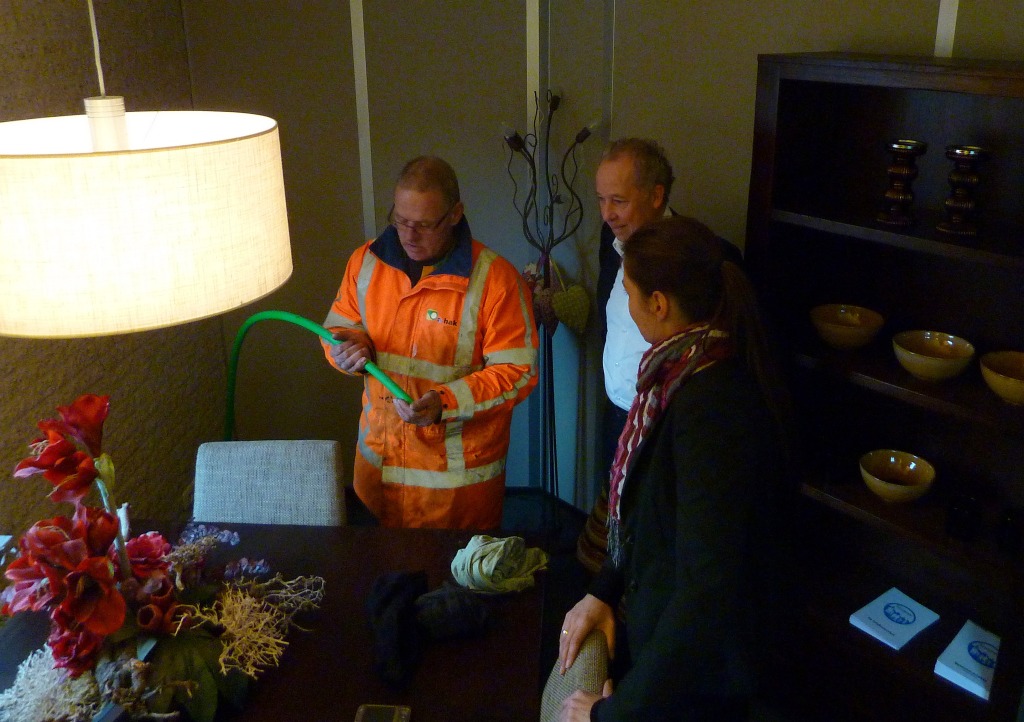
 Incidentally, I was around when some collegues were starting the construction of a glassfiber connection for the 'Heidepunt' in Twijzelerheide. We were planning to demonstrate the Byldskermloket, the video service desk. Representatives of the Achtkarspelen municipality, Home care institution Thuiszorg De Friese Wouden and reintegration organisation Raderwerk had just seated themselves when an enormous drill was started.